INTERNATIONAL TRADE
Namibia Seeks to Expand Exports to More EU Member States
Six European Union member states accounted for about 95% of Namibia’s exports to the bloc in 2025, while Government wants local firms to use the trade agreement to reach more markets and add value at home.
Namibia is seeking to expand its exports to more European Union (EU) member states after six of the bloc’s 27 countries accounted for about 95% of the country’s exports to the market in 2025, highlighting the need for local businesses to make better use of the existing trade agreement.
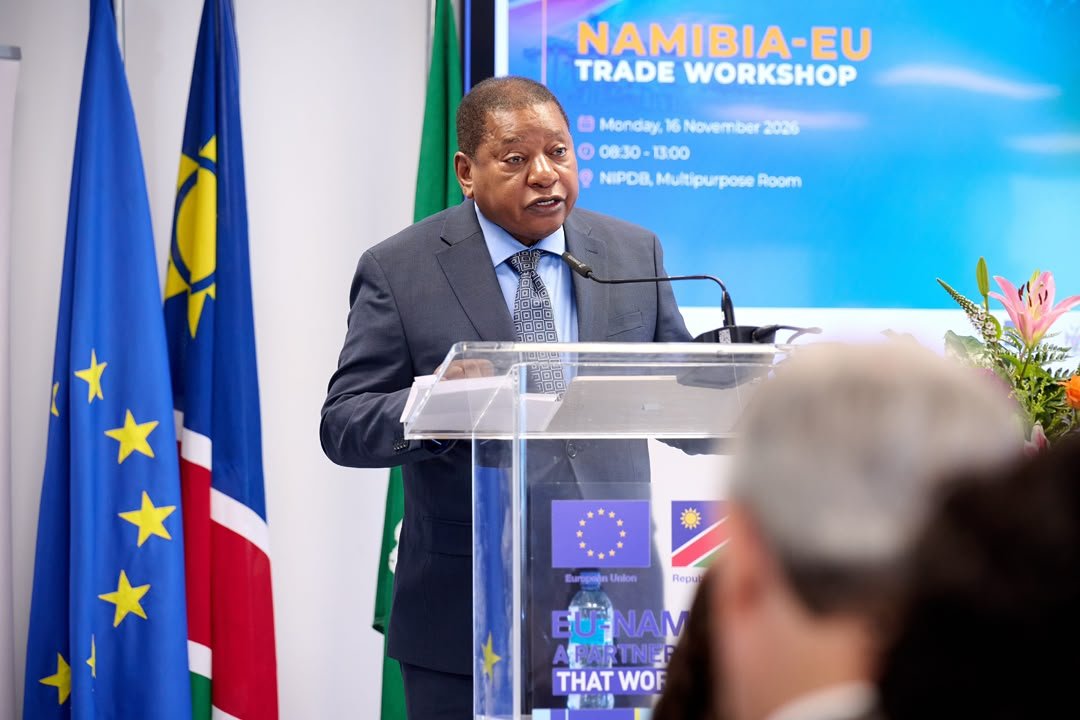
Speaking at the Namibia-EU Trade Relations Stakeholder Workshop in Windhoek on Monday, Ministry of International Relations and Trade Executive Director, Jerobeam Shaanika said Namibia needed to strengthen its ability to compete in international markets and expand the range of products it exports.
The six countries include, Spain, France, Netherlands, Italy, Belgium and Germany, accounted for the largest share of Namibia’s exports to the EU, according to a study conducted by independent Economist, Robin Sherbourne using Namibia Statistics Agency data.
The study showed that the EU remained Namibia’s third-largest export market in 2024 and 2025, with exports to the bloc increased from N$14.975 billion in 2024 to N$17.567 billion last year.
The Southern African Development Community (SADC)-EU Economic Partnership Agreement (EPA) gives qualifying Namibian products duty-free and quota-free access to the European market, subject to rules of origin and quality standards.
However, Shaanika said access to the market did not automatically translate into increased exports or industrialisation.
“We must have the productive capacity, competitiveness, investment, infrastructure and institutional support necessary to take full advantage of the opportunities available to us,” he said.
He said Government wanted local businesses to use the trade agreement to reach more markets and expand the range of products they sell internationally, while strengthening local processing and manufacturing.
Shaanika said Namibia needed to move beyond exporting mainly raw and minimally processed commodities and increase its participation in higher-value segments of international value chains.
“Our ambition must be to ensure that Namibia does not merely serve as a source of raw materials for international markets, but increasingly becomes a producer of value-added goods, a destination for productive investment and a competitive participant in global trade,” he said.
He said these priorities were reflected in the Sixth National Development Plan (NDP6), which focuses on export diversification, industrialisation, value addition and stronger domestic productive capacity.